

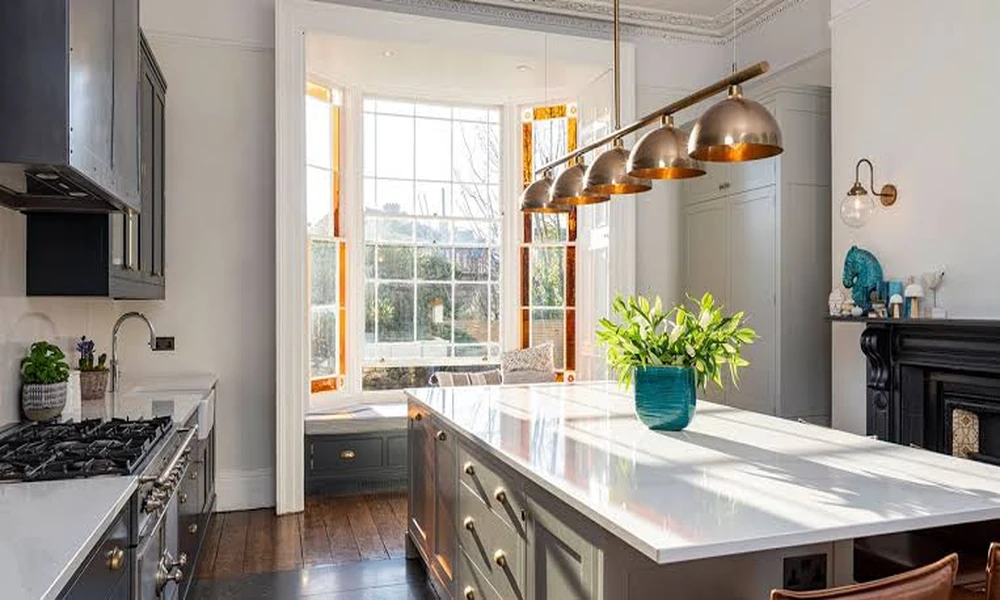
Why Generic Fixtures Fall Short for Islands
Most kitchen islands are lit by a single builder-grade fixture that was chosen for cost rather than function, and it shows the moment you try to chop vegetables or read a recipe on your phone. Islands have become the workhorse of the modern kitchen, hosting everything from meal prep to homework to weekend coffee, yet the lighting above them often hasn’t kept pace with that shift. A dim or oddly placed fixture casts shadows exactly where you need clarity, forcing people to lean or shift to see what they’re doing. Over time, this mismatch between how the space is used and how it’s lit becomes a daily annoyance rather than a one-time inconvenience. This is especially true in open-concept homes, where the island functions as the visual centerpiece of the entire main floor and any lighting shortfall becomes impossible to ignore.
The issue isn’t limited to brightness. Many older fixtures throw a narrow cone of light that leaves the edges of the island in shadow, which is a problem when two or three people are working around it at once. Color temperature matters too; a fixture that runs too warm or too cool can make food look unappetizing or turn a countertop the color of a hospital hallway. Homeowners often notice the problem only when they start comparing their kitchen to photos in a magazine or a listing for a home down the street, and by then the outdated fixture has been quietly working against the room for years.
How Pendant Lighting Solves the Island Problem
One of the more direct fixes is to replace the existing fixture with pendant lighting for kitchen island sized and spaced for the island itself rather than the room as a whole. Pendants hung at the correct height and interval concentrate light exactly where prep and conversation happen, without washing out the rest of the kitchen. This approach treats the island as its own zone, distinct from the overhead ambient lighting used elsewhere in the room. It also gives the space a visual anchor, since a well-chosen set of pendants tends to draw the eye and set the tone for the kitchen’s overall style.
Getting the approach right involves more than picking a shape people like in a showroom. Spacing between fixtures should relate to the island’s length, and hanging height needs to account for ceiling height and the sightlines of anyone standing across the counter. A pair of pendants might suit a smaller island, while a longer one often calls for three fixtures spaced evenly to avoid dark gaps at either end. Getting these proportions wrong is a common reason new pendants still feel underwhelming even after the swap, so it pays to measure before ordering rather than after.
Choosing Bulbs and Shades That Actually Work
Bulb choice deserves as much attention as the fixture itself. A warm white in the 2700 to 3000 Kelvin range tends to suit kitchens because it renders food and skin tones accurately without feeling clinical. Dimmable options are worth the small added cost, since the right brightness for chopping vegetables is rarely the right brightness for a relaxed dinner conversation. Glass or fabric shades diffuse light more gently than open bulbs, which reduces glare for anyone sitting at the island rather than standing over it.
Efficiency is another factor that’s easy to overlook until the electric bill arrives. Fixtures and bulbs that meet ENERGY STAR lighting guidance tend to use a fraction of the energy older incandescent setups required, while lasting considerably longer before needing replacement. It’s worth checking the wattage equivalency listed on the packaging rather than assuming a lower number means dimmer light, since LED technology has changed those ratios substantially. A little research before buying saves both money and the hassle of returning fixtures that don’t match expectations once installed.
