

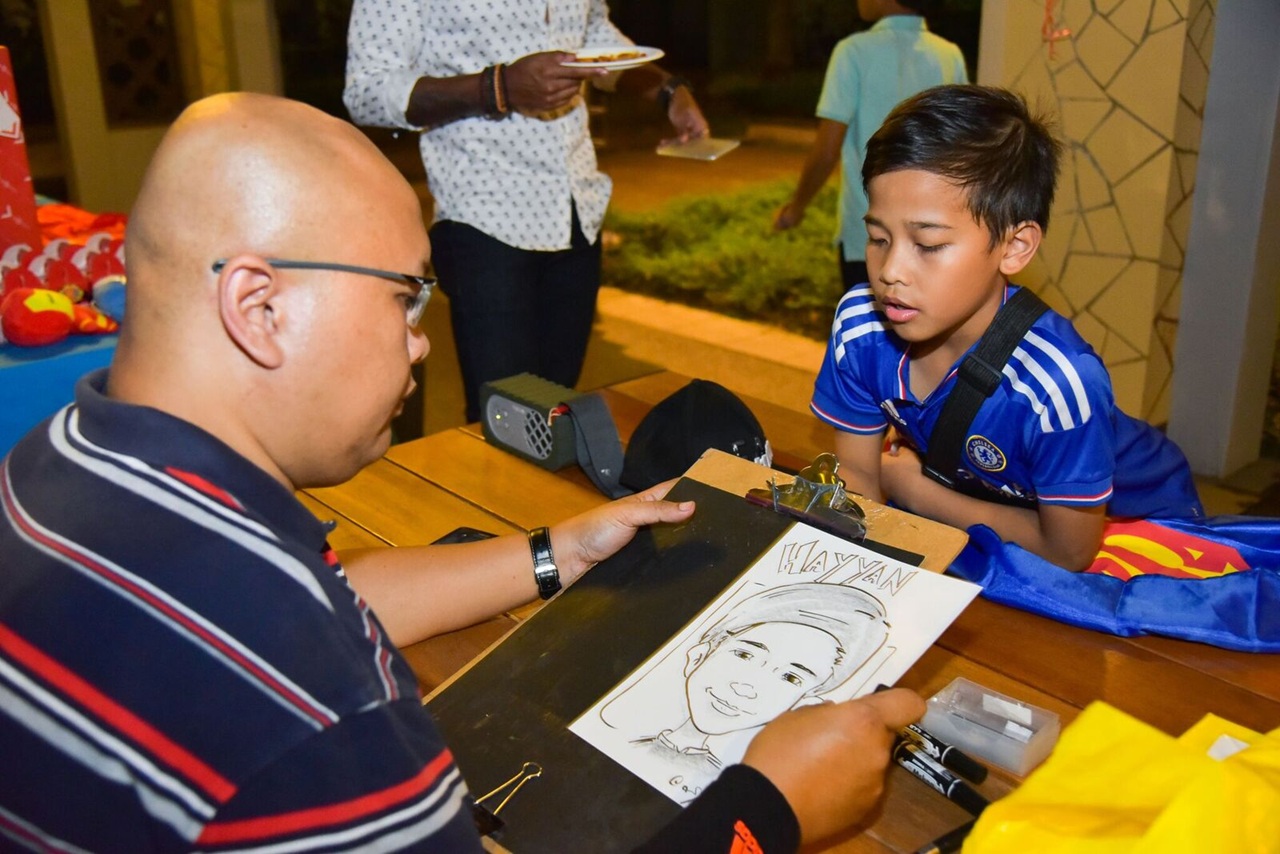
The proliferation of caricature services across Singapore’s event industry represents something curious about how contemporary societies construct memorable experiences. Here exists an art form predicated on exaggerating human features to the point of gentle mockery, yet it has become sought-after entertainment for corporate functions, weddings and children’s parties. This transformation from street corner novelty to professional event component illuminates broader patterns in how we conceive of entertainment and social interaction.
These are no longer spontaneous encounters with boardwalk artists but carefully scheduled components of celebrations, complete with booking systems, hourly rates and performance metrics.
The Economics of Exaggeration
Understanding caricature as an event service requires acknowledging its dual function. Practitioners simultaneously perform entertainment and manufacture physical products. Unlike purely performative arts that exist only in the moment, caricature artists create tangible objects outlasting the events themselves. As industry professionals observe, these services provide a novel and unique personalised souvenir, creating keepsakes that last for a lifetime unlike more common activities such as face painting or balloon sculpting.
This material dimension alters the economic calculation for event planners. The service delivers not merely temporary amusement but distributes personalised mementos. Each guest departs with physical evidence of participation. For corporate clients particularly, this tangible dimension carries significant value.
The production metrics reveal the systematic nature of contemporary caricature services. Professional artists working at events can achieve 12 to 15 people drawn per hour for black and white portraits, with coloured versions reducing output to roughly eight to twelve individuals per hour. These standardised productivity measures allow event planners to calculate coverage, determining how many artists to book based on anticipated guest counts and desired service levels. The ancient art of caricature has been thoroughly quantified, measured and scheduled.
Event organisers can now predict with reasonable accuracy how many guests will receive portraits within specific timeframes, adjusting artist numbers accordingly. A corporate function expecting 150 attendees over two hours might engage multiple artists to ensure adequate coverage. This mathematical precision transforms what was once unpredictable artistic performance into reliably managed event components.
The Peculiar Appeal Across Demographics
What makes caricature effective as event entertainment is its ability to engage diverse age groups simultaneously. As practitioners note, whether attendees are six, sixteen or sixty years old, caricature proves entertaining to watch for everyone. This cross-generational appeal addresses a persistent challenge in event planning.
Most entertainment options skew heavily towards particular demographics. Children’s performers bore adults. Sophisticated entertainment loses young attention. Against these limitations, caricature offers something qualitatively different.
The appeal operates on multiple levels:
- The performance aspect as guests watch artists work provides visual entertainment accessible to all ages
- The participatory element when individuals sit for their portraits creates structured interaction
- The humorous exaggeration transcends cultural and generational boundaries
- The tangible output provides immediate gratification and lasting memorabilia
- The personalisation ensures each guest receives individualised attention
This multidimensional engagement explains why event planners increasingly incorporate caricature despite what industry observers note remains relatively novel status, as caricature services are not yet a staple amongst events in Singapore. This novelty factor itself contributes value, allowing hosts to differentiate their events from competitors. In markets where attendees experience multiple similar functions annually, memorable distinctions matter significantly. An activity that most guests have not encountered at previous events carries inherent appeal, sparking conversation and creating talking points that extend beyond the immediate occasion.
Technical Evolution and Digital Adaptation
The transition from traditional paper sketches to digital caricature represents more than technological updating. It fundamentally reshapes what the service delivers and how value gets perceived. Digital artists working on tablets can instantly distribute soft copies to guests, incorporate event logos or custom backgrounds, and maintain archives clients can access indefinitely. The immediacy aligns with contemporary expectations for instant gratification and social media sharing.
Yet this evolution introduces questions about authenticity. The market suggests both formats maintain distinct appeal. Traditional sketches offer tangible uniqueness. Digital versions provide shareability and customisation flexibility.
The Corporate Adoption Pattern
Perhaps nowhere has caricature’s transformation been more pronounced than in corporate contexts. Companies that measure return on investment now routinely budget for artists to sketch employees at family days and clients at trade shows. This adoption reflects several calculations beyond entertainment value.
Corporate caricature serves ice-breaking functions at networking events. The activity generates social media content as recipients photograph and share portraits. Custom branding allows companies to subtly reinforce messaging. The service creates positive associations through the pleasure of receiving personalised gifts.
Most significantly, corporate caricature addresses the challenge of making events memorable. In a landscape where companies compete for attention through elaborate celebrations, differentiation becomes crucial. Caricature provides distinctive experiences that attendees remember and discuss afterwards.
What This Reveals About Contemporary Entertainment
The success of professional caricature services illuminates broader patterns in how modern societies construct entertainment experiences. We increasingly favour activities combining performance with tangible outputs, passive observation with active participation, and group entertainment with individual personalisation. Measurable productivity allows systematic planning. Cross-demographic appeal maximises return on investment.
Whether this represents cultural evolution or commodification of spontaneity depends on perspective. What seems beyond dispute is that an art form once associated with political satire has been thoroughly professionalised and integrated into Singapore’s formal event industry. Those seeking to book caricature services today encounter not bohemian artists but established professionals who arrive punctually, deliver predictable quality and invoice systematically, transforming gentle mockery into memorable experiences one exaggerated portrait at a time.
